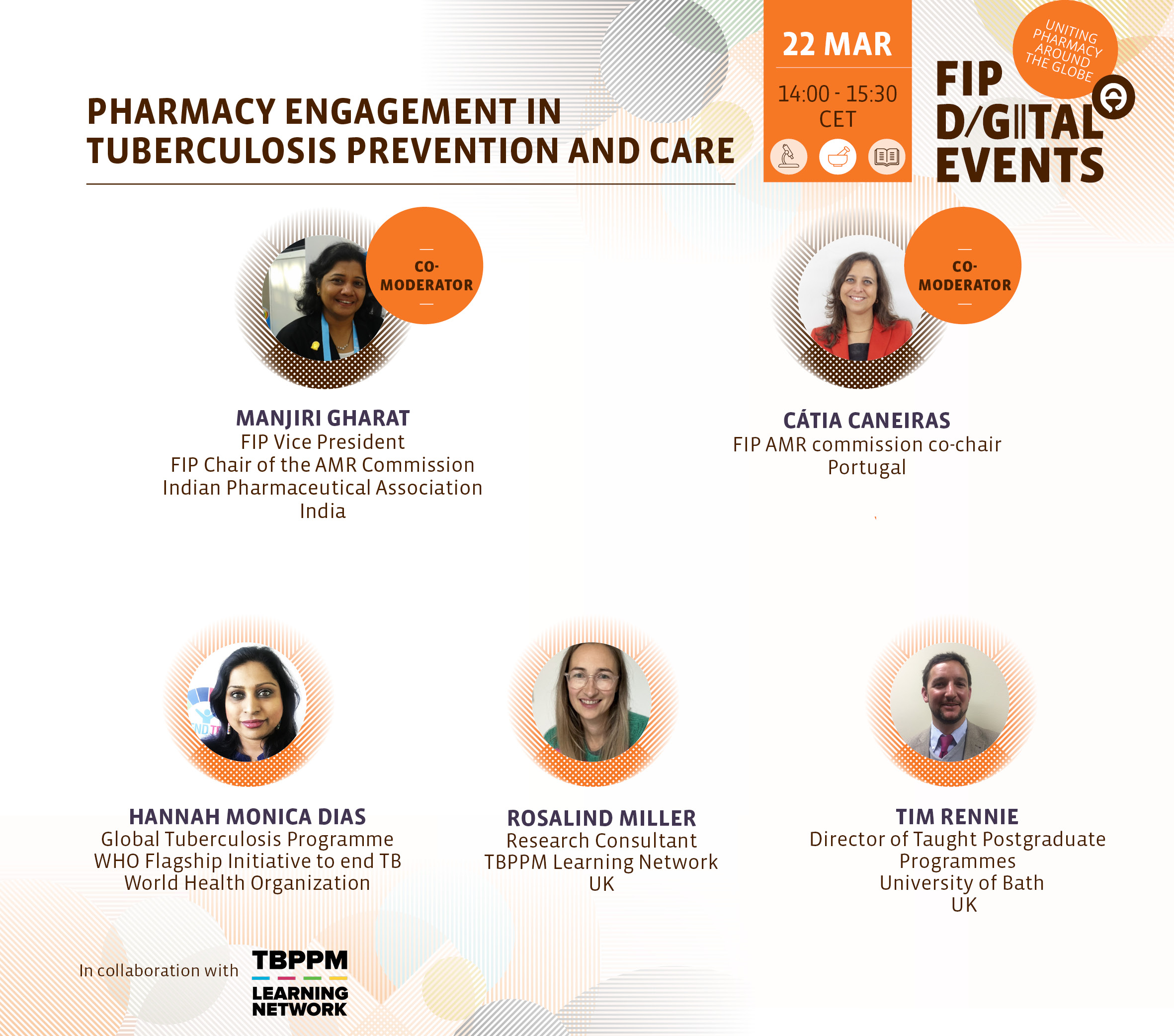
Tuberculosis (TB) is a preventable and curable disease. However, according to the WHO, in 2022, it affected 10.6 million people worldwide and caused 1.3 million deaths. TB occurs in all countries and in people of all ages. Multi-drug resistant TB (MDR-TB) remains a public health crisis and a threat to health security, with only about two in five people receiving treatment in 2022. In this digital event, experts will explore the role that pharmacists play in the fight against TB, and how this role can be further leveraged. This event marks World TB Day and aims to strengthen pharmacy engagement, foster collaboration and contribute to a TB-free world through collective expertise and commitment.

Pharmacy engagement in tuberculosis prevention and care
Page: Viable Diseases
Integrating point-of-care testing in community pharmacy practice: Findings from a global intelligence report
Pharmacy professionals are fully committed to an interprofessional and person-centred approach to healthcare. Where the regulatory framework allows, a wide range of point-of-care tests (POCT) can be carried out in community pharmacies. POCT can be incorporated into disease management programmes to monitor the effects of treatment in people living with non-communicable diseases. In addition, in acute situations, pharmacy professionals can use POCT to support clinical decision-making and provide rapid, safe pharmaceutical care. These tests provide valuable data to inform health-related decisions and reduce avoidable visits to primary care physicians or emergency departments. At this event, FIP will launch a global intelligence report on pharmacy-based point-of-care testing.
The role of pharmacy professionals in point-of-care testing
Pharmacy professionals are fully committed to an interprofessional and person-centred approach to healthcare. Where the regulatory framework permits, a broad range of point-of-care (POC) tests can be performed at community pharmacies or clinical biology laboratories. POC tests can provide valuable information to support health-related decision making and reduce unnecessary presentations to general practitioners or emergency departments. POC tests may also be provided as part of a disease state management service to monitor the outcomes of treatment in people with chronic non-communicable diseases. In addition, pharmacy professionals can use POC tests to intervene and provide safe and quick pharmaceutical care in acute situations.
Pharmacists support to medication management for people living with HIV
Preventing new HIV infections is one of the most important steps towards curbing the HIV epidemic. Pharmacists are ideally placed to support prevention strategies that can reduce the risk of transmission, including advice on safer sex practices, supporting the use of pre- or post-exposure prophylaxis (PrEP/PEP) and supporting harm reduction strategies for intravenous drug users. Managing and optimising treatments in people living with HIV is another important way in which pharmacists can contribute. This event aims to explore options on how to assess and support patients, establish adherence strategies, manage side effects, provide counselling on lifestyle factors, and make appropriate referrals. Further, this event aims to provide skills to optimise HIV therapy, identify and resolve medication-related problems, collaborate with the care team, and empower patients to improve health outcomes.
Pharmacists’ contributions to HIV prevention and management

The first of December commemorates World AIDS day and this year FIP will join this campaign by launching a toolkit for pharmacists on HIV prevention, screening and management. It is now possible to effectively prevent the transmission of HIV through pharmacological strategies (preexposure and postexposure prophylaxis). New HIV tests have also become available, including point-of-care tests and self-tests. Pharmacists’ expertise and accessibility can be leveraged for a variety of important roles in the prevention and screening of HIV infections. Join this event to learn about these roles and be inspired by examples from different countries.
The role of pharmacists in the prevention, screening and treatment management of HIV: An international update

At this event on World AIDS day, we will explore the different roles pharmacists can have in the prevention and screening of HIV infections, as well as in providing care and support to people living with HIV, namely through medication management. Other roles for pharmacists include HIV prevention through dispensing and providing support to preexposure prophylaxis (PrEP), HIV testing and harm reduction strategies for IV drugs users.
The World Health Organization estimates that around 38 million people live with HIV globally. Although there is still no cure for HIV, with the advancement of therapies and increasing access to effective HIV prevention, diagnosis, treatment and care, including for opportunistic infections, HIV infection has become a manageable chronic health condition, enabling people living with HIV to lead long and healthy lives.
The role of the pharmacist in the prevention and management of vector-borne diseases: European region

Pharmacists are uniquely positioned to help communities and patients protect themselves from vector-borne diseases (VBDs). This webinar will describe the most prevalent VBDs in the European region and identify the most relevant roles that pharmacists can play in their prevention (including vector-control strategies and other measures), management and optimal treatment.
The role of the pharmacist in the prevention and management of vector-borne diseases: African region

Pharmacists are uniquely positioned to help communities and patients protect themselves from vector-borne diseases (VBDs). This webinar will describe the most prevalent VBDs in the African region, and identify the most relevant roles that pharmacists can play in their prevention (including vector-control strategies and other measures), management and optimal treatment.
IN SPANISH El farmacéutico en la prevención y manejo de las enfermedades transmisibles por vectores: una perspectiva de la región de las Américas
Los farmacéuticos tienen una posición privilegiada para ayudar a las comunidades y a los pacientes a protegerse de las enfermedades transmitidas por vectores (ETV). En este webinar se describirán las ETV con mayor prevalencia en las Américas; posteriormente se identificaran las intervenciones farmacéuticas más relevantes en este ámbito y por último se presentarán tres experiencias desarrolladas por el Foro Farmacéutico de las Américas referentes al abordaje farmacéutico de las ETV
IN PORTUGUESE Desafios e Oportunidades para a Profissão Farmacêutica no espaço lusófono –Doenças transmitidas por vetores
Um webinar intitulado “Desafios e Oportunidades para a Profissão Farmacêutica no espaço lusófono –Doenças transmitidas por vetores” teve lugar no dia 28 de abril, às 18:00 horário de Portugal, organizado conjuntamente pela Federação Internacional Farmacêutica (FIP) e a Associação de Farmacêuticos dos Países de Língua Portuguesa (AFPLP) em língua portuguesa. Este webinar foi baseado no Manual da FIP para Farmacêuticos sobre doenças transmitidas por vetores, produzido em colaboração com o o Fórum Farmacêutico das Américas. Os oradores apresentaram e discutiram estudos de caso de vários países lusófonos sobre o papel único dos farmacêuticos na prevenção e gestão de doenças transmitidas por vetores.
